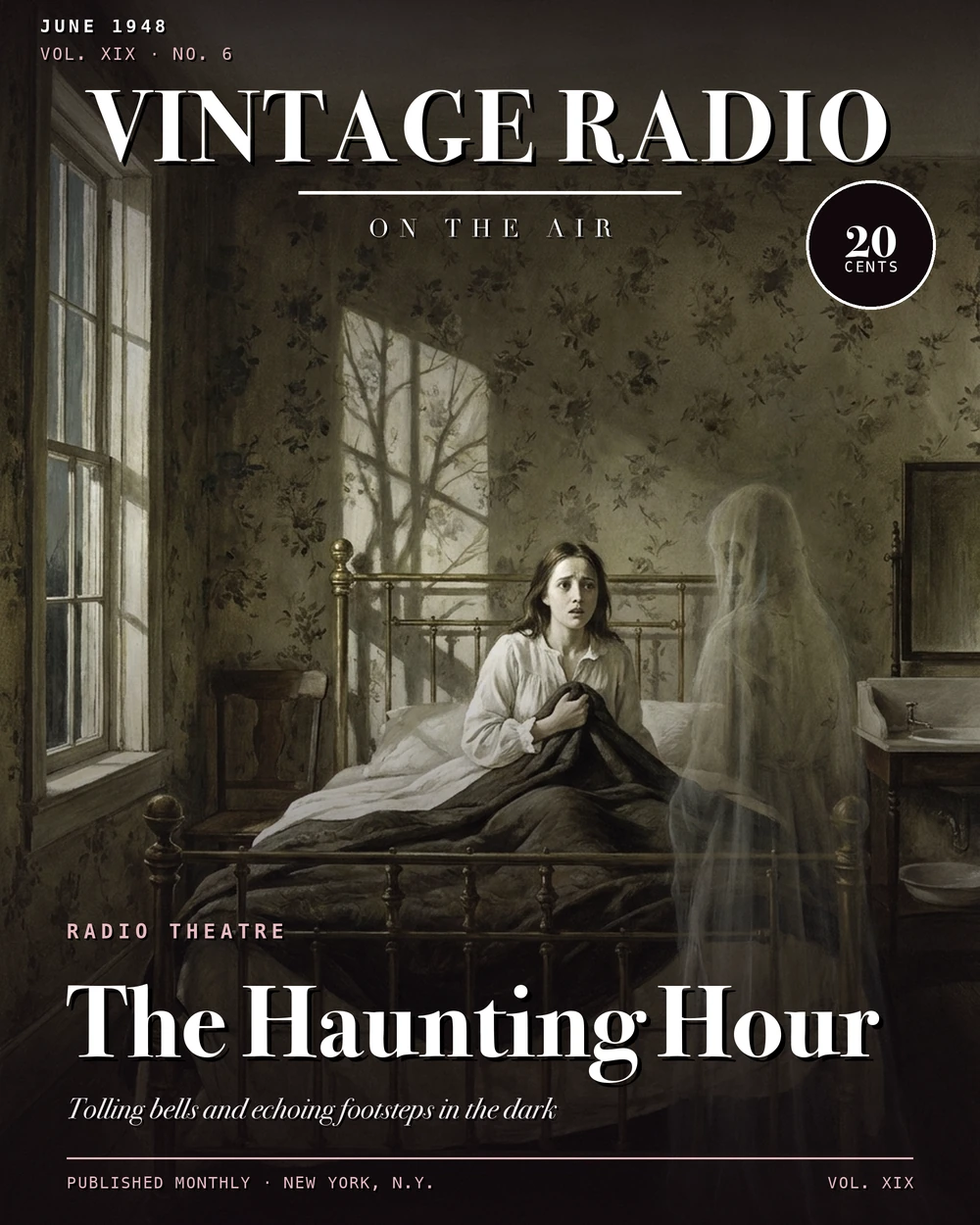
The Haunting Hour
Mystery at Its Best
"No... No, stay where you are. Do not break the stillness of this moment." That was how each episode opened — organ music swelling, footsteps echoing in time with the beat, and the host's hushed warning easing the listener into thirty minutes of melodrama. The show billed itself on air as "Mystery at its Best," and the catch-all was accurate: psychological mysteries, whodunits, crime stories, the occasional ghost. Each episode closed with the same tag: "From shadows and stillness, mystery weaves a spell of strangest fascination, charging the mind with doubts and fears. For mystery is a strange companion, a living memory in The Haunting Hour."
The title was a small lie. Episodes ran thirty minutes, not an hour, and the show was rarely if ever scheduled at midnight despite what the name implied. The atmosphere was the point, not the arithmetic.
How It Got Made
The series was produced by NBC's Radio Recording Division, an in-house unit that had originally been set up to record live network programming for internal use, then expanded into pressing short programs on disc for sale to local affiliates. The model was straightforward: ship transcription discs to stations along with production notes for the local announcer to read, leaving room for whatever sponsor was paying the bills in that market. Because the local sponsor messages carried the freight, cast and crew credits were routinely omitted from the discs themselves — which is why, despite the show's reach, no episode tells you who was in it.
The Haunting Hour was the division's answer to ZIV Syndications' The Weird Circle (1943), which had proven there was money in transcribed horror anthology. By 1945, NBCRRD was advertising itself as "America's No. 1 source of recorded programs," and the model worked: Variety reported 99 stations carrying the series as of 1947, with licensing set at $150 per episode in larger markets and $100 elsewhere. Fifty-two unique scripts were produced. OTR historian Karl Schadow, quoted at Tangent Online, noted that as a syndicated transcription the series carried no official broadcast dates and "could still be heard on various markets into the early 1960s." Episodes were re-syndicated again in the early 1970s in a 26-episode package, with a separate numbering system that has never been reconciled against the original.
The Voices We Can Identify
Despite the missing credits, a few names have been pinned down. Berry Kroeger handled announcing duties for most episodes — a veteran who had started in radio in 1931 as a teenager, signed with CBS in 1936, served as the very first announcer for Suspense in its early New York run, and appeared on Inner Sanctum and Orson Welles's Mercury Theatre on the Air. He later moved to film, specializing in noir villains in Act of Violence, Cry of the City, The Iron Curtain, and Gun Crazy.
Bret Morrison, the definitive radio voice of The Shadow, turned up in multiple episodes. Morrison had entered radio in high school on The First Nighter Program and carried continuing roles on Guiding Light, The Romance of Helen Trent, and other network serials alongside his Shadow work; he died in 1978 of a heart attack after taping an episode of Heartbeat Theater, found slumped over his steering wheel.
The organ underneath all of it was Rosa Rio — born Elizabeth Raub in New Orleans, the NBC staff organist known as the "Queen of the Soaps." Rio had joined NBC in 1938 as the first woman hired into the orchestra (which then had 156 men, and would wait another decade before hiring a second), and over a 22-year radio career she played for 24 soap operas and dramas, sometimes five to seven shows in a single day. She died in 2010 at 107.
What Survives
Roughly 41 of the 52 scripts have survived into circulation, with at least eleven additional uncirculated episodes transcribed for Armed Forces Radio held in archival collections. Surviving titles give a fair sense of the range: "Murder Wears a Strange Mask," "Bird of Death," "The Old, Old Men," "Ptolomy's Grave," "A Corpse There Was," "If the Shoe Fits," "Breakdown," "The Hands of Mr. Smith," "Homicide House," "The Unidentified Body." Some have been transferred from the original NBC Orthacoustic discs — NBC's proprietary format for transcription releases — which is about as close to the source as the historical record allows.
Female protagonists turn up in many of the surviving episodes, a pattern that has been read as a deliberate appeal to the soap opera audience, with ghosts and murders grafted onto the daytime formula. For a series whose makers left no signatures, the recordings have done the identifying work the credits never did.